




The new Italian hunting bill and the interests of a few





 Commenti
by Alessandro Fazzi and Martina Pluda*
The way a bill makes its way through Parliament often reveals more than the bill itself.
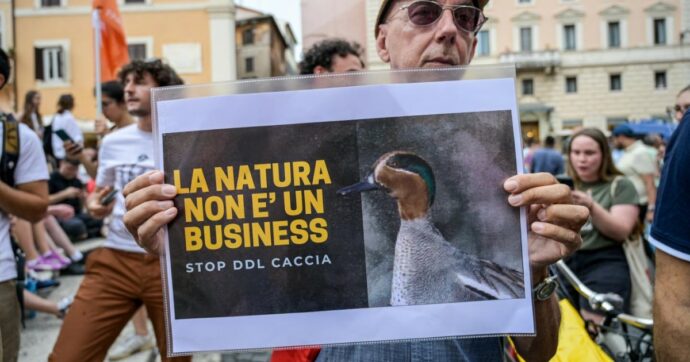
In recent weeks, public and political debate over Italy’s proposed Hunting Bill—dubbed the “Shoot-Everything Bill”—has intensified, with specific concerns raised about its scientific basis, its constitutionality, and the narrow interests it appears to serve. Yet there is another question that deserves just as much attention as the one concerning the bill’s substance: why do some legislative proposals race through Parliament while others remain stalled for entire legislative terms?
Whenever legislation that primarily benefits narrow sectoral interests is fast-tracked while other initiatives serving the wider public interest remain stalled for years, the cost is not merely legislative. It is democratic. Trust in public institutions is not lost overnight. It erodes gradually, every time people are left with the impression that political participation matters less than having access to—and influence over—the places where decisions are made.
In that sense, the issue goes beyond the objectives of this bill—the shortcomings of which have already been extensively highlighted by many authoritative voices—to what its legislative journey tells us about which interests receive an immediate political response and which do not.
A striking comparison illustrates the point. For years, a bill to ban the import, export, and re-export of hunting trophies from internationally protected endangered species, a measure with broad public support, has remained dormant at committee stage, never making its way onto the Parliament’s agenda. That proposal (Senate Bill No. 822), introduced in July 2023, is still awaiting substantive consideration in committee. By contrast, the Hunting Bill (Senate Bill No. 1552 / Chamber Bill No. 2984), introduced in June 2025, completed its passage through the Senate within twelve months and has already moved to the Chamber of Deputies, progressing at an unusual quick speed.
This disparity is no accident. It reflects the way legislative priorities are set within the Italian Parliament. Once a bill is assigned to a parliamentary committee, it is the committee that effectively controls its progress. Committee chairs enjoy broad discretion in determining work programmes and legislative calendars, and in deciding which proposals move forward and which remain on hold. These powers are subject to few procedural constraints.
Giving priority to the Hunting Bill over the trophy hunting import ban reflects a political judgment about urgency and legislative opportunity. The different pace at which these two proposals have advanced is not an institutional anomaly. It is the natural consequence of the wide organisational autonomy enjoyed by parliamentary committees and, ultimately, of the political and electoral priorities established by the governing majority regarding hunting policy and animal protection.
The real matter in this situation is not simply about the merits of the two bills nor whether the hunting bill itself is right or wrong. It is about the message conveyed by the way a bill is advanced. In other words, it is about how political urgency is defined—and by whom.
Anyone seeking to understand what truly shapes Italy’s political priorities should look beyond election manifestos. The parliamentary committee calendar often tells the more revealing story. It is there that political choices become visible and priorities are ultimately established. It is those priorities that deserve public scrutiny, especially when they appear to favour a constituency representing less than one per cent of the Italian population, despite the fact that hunting legislation has already been the subject of significant reforms during the current legislature through multiple laws and emergency decrees.
Ultimately, the quality and strength of a democracy should not be measured only by the laws it passes—or by the speed at which it passes them, including the increasingly frequent use of emergency decree-laws—but also by the laws it chooses not to debate. Whenever proposals backed by well-organised and favoured special interests are placed on a fast track, while others remain untouched for years despite serving the broader public interest, the issue extends far beyond hunting, animal welfare or nature conservation. It concerns all of us as individual citizens in a democracy.
Trust in institutions is not undermined only by decisions we disagree with. It is undermined when citizens begin to doubt that political priorities bear any meaningful resemblance to their own.
* Humane World for Animals Italy